Introduction
In 2026, satellite communications are rapidly evolving from hardware-heavy deployments into cloud-managed, software-defined infrastructure services.
One of the most important developments driving this transformation is the integration of TDMA (Time Division Multiple Access) satellite networks with Ground Segment as a Service (GSaaS).
Together, TDMA and GSaaS are enabling enterprises, governments, and service providers to build scalable, flexible, and cost-efficient satellite networks without owning traditional ground infrastructure.
What Is a TDMA Satellite Network?
TDMA satellite networks allow multiple remote terminals to share a single satellite channel by dividing transmission time into scheduled time slots.
This architecture enables:
- Efficient bandwidth sharing
- Scalable remote site connectivity
- Centralized network control
- Predictable capacity allocation
Traditional TDMA networks are widely used in:
- Maritime communications
- Remote enterprise networks
- Government communications
- Energy and mining operations
What Is GSaaS (Ground Segment as a Service)?
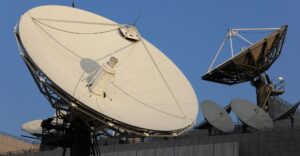
GSaaS is a modern model where satellite ground infrastructure is delivered as a cloud-based service rather than owned hardware.
Instead of building and maintaining physical ground stations, organizations access:
- Distributed antenna networks
- Cloud-based RF processing
- Virtualized modem environments
- Automated scheduling systems
- API-driven satellite access
Recent industry architecture shows GSaaS evolving into a virtualized global ground layer supporting multi-orbit and multi-mission operations. ([Astralintu][1])
How TDMA and GSaaS Work Together
The combination of TDMA networks and GSaaS creates a new operational model:
1. Cloud-Controlled Bandwidth Allocation
TDMA slot assignments are managed dynamically through cloud platforms, allowing:
- Real-time bandwidth adjustment
- Priority-based traffic handling
- Application-aware routing
2. Virtualized Ground Infrastructure
GSaaS replaces fixed ground stations with:
- On-demand antenna access
- Automated satellite tracking
- Software-defined RF processing
3. Centralized Network Orchestration
Operators gain a single control plane to manage:
- Remote terminals
- Satellite capacity
- Traffic policies
- Service levels
Architecture of a TDMA + GSaaS Network
A modern architecture typically includes:
- Remote terminals (VSAT / maritime / enterprise sites)
- TDMA hub or cloud scheduler
- GSaaS ground station network
- Cloud NOC (Network Operations Center)
- Multi-orbit satellite layer (GEO / LEO / MEO)
This creates a fully software-driven connectivity ecosystem.
Modern research highlights how cloud-ground integration is becoming fundamental to multi-orbit satellite networks, enabling scalable and distributed operations. ([ResearchGate][2])
Key Benefits for Enterprises
1. Faster Deployment
No need to build physical ground stations or hubs.
2. Lower Capital Expenditure
Infrastructure is consumed as a service.
3. Global Scalability
Enterprises can expand networks across regions instantly.
4. Higher Resilience
GSaaS redundancy ensures continuity even if individual stations fail.
5. Centralized Security Control
All network traffic and TDMA scheduling can be managed under a unified security framework.
Use Cases
Maritime Networks
Ships use TDMA for:
- Fleet operations
- Crew communications
- IoT tracking
GSaaS ensures global coverage without owning teleport infrastructure.
Remote Industrial Sites
Mining, oil & gas, and energy operations benefit from:
- Stable connectivity
- Managed bandwidth
- Automated failover systems
Government and Defense Networks
TDMA + GSaaS supports:
- Secure communications
- Mission-critical operations
- Disaster response connectivity
Enterprise Backup Connectivity
Organizations deploy TDMA + GSaaS as:
- Primary or backup WAN links
- Disaster recovery pathways
- Business continuity systems
The Shift from Hardware to Cloud-Based Satellite Networks
The satellite industry is undergoing a major transformation:
From:
- Fixed ground stations
- Manual RF operations
- Hardware-heavy networks
To:
- Cloud-managed GSaaS platforms
- Software-defined TDMA control
- Virtualized global ground infrastructure
This transition is part of a broader move toward software-defined space systems and cloud-native satellite operations.
Future Outlook: Autonomous Satellite Networking
The next evolution of TDMA + GSaaS will include:
- AI-driven bandwidth optimization
- Autonomous network routing
- Predictive satellite scheduling
- Self-healing network architectures
These innovations will reduce human intervention and improve global service reliability.
Conclusion
TDMA satellite networks combined with GSaaS represent a fundamental shift in how satellite communications are designed and operated.
Instead of owning infrastructure, organizations can now subscribe to fully managed satellite network capability.
In 2026 and beyond, the winners in satellite communications will be those who adopt:
- Cloud-managed ground systems
- Software-defined TDMA networks
- Multi-orbit integration
- Automated network orchestration
The future of satellite connectivity is not hardware ownership — it is network-as-a-service intelligence.